Do Flock Cameras Flash at Night? The Science Behind the Red Glow & Night Vision Technology (2026)
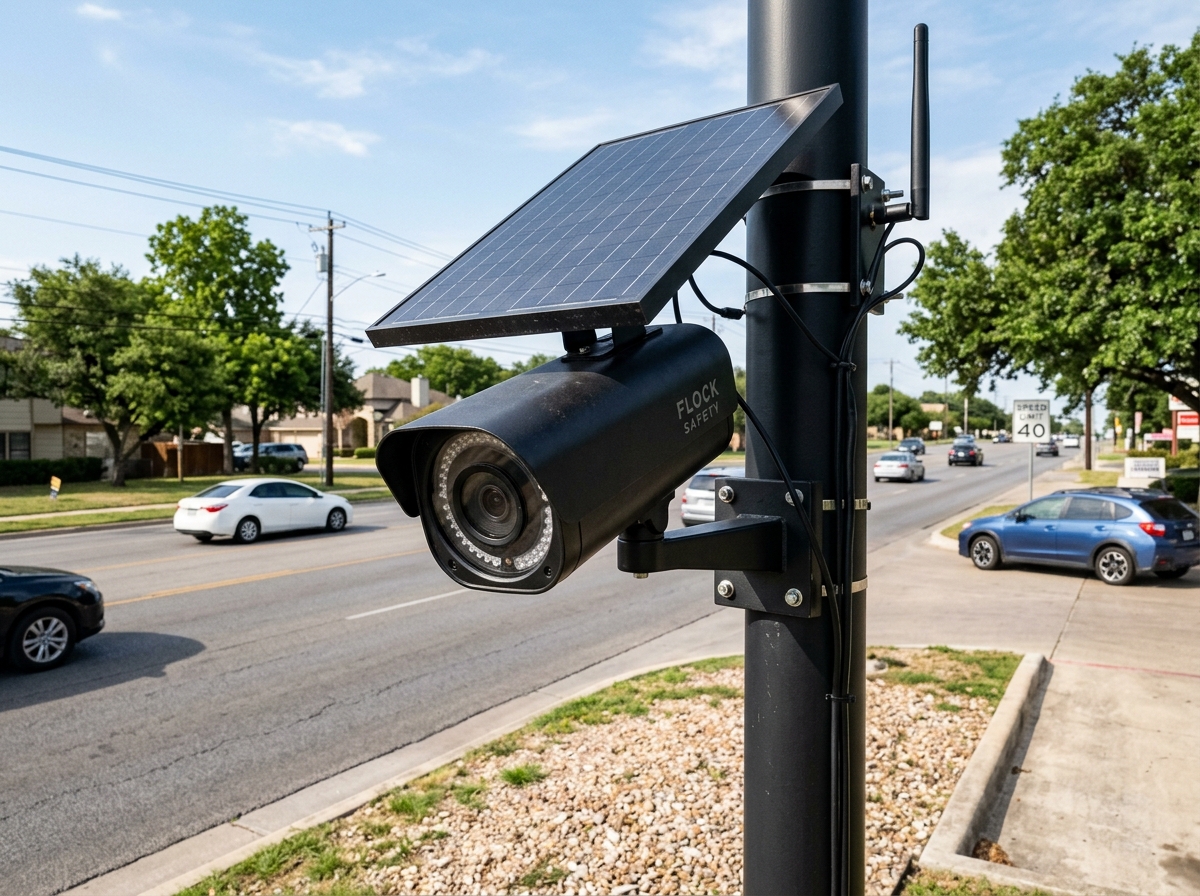
Do Flock Cameras Flash at Night? The Definitive Guide
One of the most frequently asked questions by night motorists, commuters, and suburban residents is: "Do Flock cameras flash at night?" or "Why did that black pole-mounted camera just glow red as I drove past?"
If you have ever driven through an intersection, residential boulevard, or highway off-ramp after dark and observed a sudden, subtle cherry-red flicker or twin dim red dots perched high on a utility pole, you have encountered a Flock Safety automated license plate reader (ALPR) executing its night-capture sequence.
This comprehensive technical guide explains the exact optical science, illumination wavelengths, strobe mechanics, and machine vision technologies behind Flock camera night operation in 2026.
1. Quick Answer: Do Flock Cameras Flash?
No, Flock cameras do NOT emit a bright, blinding white flash.
Unlike traditional red-light enforcement cameras or speed-trap photoradars that illuminate the entire roadway with a high-intensity xenon white strobe, Flock cameras utilize invisible near-infrared (NIR) light.
However, drivers do frequently notice a dull, faint red glow or brief crimson blink. Here is why:
- 850 Nanometer (nm) Infrared LEDs: The cameras are equipped with infrared illuminator clusters tuned to an 850nm wavelength.
- Human Visual Perception Threshold: The human eye can perceive electromagnetic radiation between approximately 380nm (violet) and 750nm (deep red). While 850nm is classified as non-visible near-infrared, the high optical power density emitted by the LEDs causes a small spillover into the very edge of the human retina's sensitivity curve.
- Pulsed Synchronization: The infrared LEDs do not burn continuously; they pulse in microsecond bursts synchronized with the camera's shutter, creating what appears to be a rapid, subtle red flicker.
2. The Physics of 850nm vs. 940nm Infrared Illumination
In modern surveillance engineering, optical sensor designers choose between two primary infrared wavelength bands: 850nm and 940nm. The choice made by Flock Safety directly explains the characteristic red glow motorists see.
| Infrared Wavelength | Visibility to Human Eye | Sensor Sensitivity & Range | Why Flock Safety Uses It |
|---|---|---|---|
| 850nm (Near-Infrared) | Faint red cherry glow visible when looking directly along the beam axis | 30% to 40% higher sensor quantum efficiency; requires less battery power for 75-foot retroreflective plate illumination | Standard on all Flock Falcon units. Delivers superior plate readability and vehicle outline detection with minimal solar battery drain. |
| 940nm (Covert Infrared) | 100% Completely Invisible (true zero glow) | Substantially reduced sensor sensitivity; requires 2.5× to 3× higher electrical power and larger LED clusters to achieve identical range | Not viable for solar off-grid ALPRs. The excessive power draw would drain solar batteries during winter nights. |
| White Xenon Strobe (400–700nm) | Blinding white flash illuminating full cabin and vehicle interior | Causes night blindness / glare to drivers; immediately signals presence of photo enforcement | Only used on traditional red-light / speed enforcement cameras, not on Flock civic ALPRs. |
By selecting 850nm illumination, Flock Safety maximizes optical contrast on state license plates while keeping overall power consumption low enough to operate indefinitely on a modest 40W solar panel and internal battery.
3. Retroreflection: How Flock Reads Plates in Pitch Black Darkness
The primary objective of a night ALPR camera is not to illuminate the driver or the asphalt, but to harness the unique optical physics of retroreflective license plates.
The Principle of Retroreflective Sheeting
Every standard license plate issued across all 50 U.S. states is coated with specialized retroreflective glass bead sheeting or microprismatic vinyl (manufactured primarily by 3M™ and Avery Dennison®).
Unlike standard diffuse surfaces (such as vehicle paint or road dirt) that scatter light in all directions, retroreflective sheeting is engineered to bounce incoming light directly back along the identical axis of the light source.
- Collimated Beam Alignment: Flock mounts its 850nm IR LED illuminators directly adjacent to the camera lens barrel (co-axial illumination).
- Selective Reflection: When the microsecond 850nm strobe fires, the vehicle's dark paint absorbs the infrared photons, while the retroreflective license plate reflects the infrared light with extraordinary intensity straight into the camera aperture.
- Extreme Dynamic Contrast: The monochrome sensor captures an image where the license plate background glows brilliant radiant white, while the stamped alphanumeric characters appear stark matte black. This extreme contrast enables edge AI neural OCR models to achieve >99% recognition accuracy even when vehicle headlights are shining directly into the lens.
4. Why Do Drivers Notice the Red Light? Common Misconceptions
Misconception 1: "A Flock Camera Just Took a Picture of My Face Inside the Car"
Fact: 850nm infrared light does not readily penetrate tinted automotive safety glass (windshields are treated with PVB interlayers and acoustic laminates that attenuate near-infrared wavelengths). Furthermore, because the camera exposure is set to fractions of a millisecond (1/2,000s to 1/5,000s) to avoid blowing out the reflective license plate, the interior passenger compartment appears almost entirely black. Flock Falcon cameras are aimed at rear or front bumper registration plates, not at driver faces.
Misconception 2: "The Red Light Means I Was Speeding or Ran a Red Light"
Fact: Flock Safety Falcon cameras are not speed enforcement or red-light cameras. They are automated license plate recognition cameras operated for investigative tracking and stolen vehicle hotlist alerting. The red pulse occurs for every single vehicle that drives through its capture zone, regardless of speed, driving behavior, or vehicle status.
Misconception 3: "Flock Cameras Flash Blue Lights"
Fact: Some cities deploy auxiliary mobile surveillance trailers (such as Live 911 or solar security towers) equipped with strobe light bars that alternate between red and blue to deter crime. Standard roadside Flock Falcon cameras do not have blue strobe lights; any blue strobe is an indicator of an unrelated municipal security trailer or specialized police deterrent beacon.
5. Comparative Breakdown: How to Tell What Just Flashed at You
| Roadside Camera Type | Night Illumination Type | Visual Driver Experience | Enforcement Function |
|---|---|---|---|
| Flock Safety Falcon ALPR | 850nm Pulsed Infrared | Faint dull cherry-red dot / subtle blink | Hotlist tracking, stolen vehicles, amber alerts, vehicle fingerprinting |
| Municipal Red-Light Camera | High-intensity White Xenon Strobe | Blinding white flash illuminating intersection | Traffic citation for crossing stop line on red light ($75–$500 fine) |
| Speed Enforcement Photoradar | High-speed Xenon or High-Power White LED | Intense white or Amber flash | Speeding ticket mailed to registered owner |
| DOT Highway Traffic Camera (CCTV) | None (relies on ambient headlights & streetlights) | No light emission whatsoever | Live traffic flow monitoring, incident response, weather checks |
7. Forensic Optical Analysis: How License Plate Reflectivity Defeats Weather and Glare
To comprehend why 850nm infrared flashes succeed where standard optical flashes fail, forensic imaging technicians evaluate what is known in optical engineering as the Modulation Transfer Function (MTF) and the Bidirectional Reflectance Distribution Function (BRDF) of automotive registration plates.
Retroreflective Microprisms vs. Glass Beads
Older legacy license plates produced prior to 2010 utilized microscopic glass beads embedded in polyurethane varnish. Modern North American plates predominantly use microprismatic retroreflective sheeting:
- Cube-Corner Microprisms: The backing material consists of millions of microscopic three-sided pyramid prisms per square inch. Light entering any corner of the prism bounces off three perpendicular internal mirrors before exiting exactly 180 degrees parallel to the entry vector.
- Why Sunlight and Glare Cause Standard Cameras to Fail: When an ordinary smartphone or visible security camera takes a flash photo of a car at night, the car's headlights flood the sensor with visible spectrum photons (400nm–700nm), causing severe blooming, lens flare, and sensor saturation.
- The Bandpass Filter Advantage in Flock Units: Flock engineers place a narrow bandpass optical filter in front of the monochrome imager. This physical optical glass filter rejects all visible light from headlights, neon signs, and streetlamps, allowing only 850nm photons to strike the sensor pixels. Consequently, in the camera's eye, headlights appear almost invisible, while the retroreflective plate shines like an illuminated neon billboard.
The Physics of High-Speed Motion Freezing
Vehicle motion blur is the single largest point of failure for municipal traffic cameras. A vehicle traveling at 70 mph (102.7 feet per second / 31.3 meters per second) will move more than an entire inch in a standard 1/1,000-second exposure.
- Flock cameras utilize a pulsed strobe width of under 150 microseconds (0.00015 seconds).
- In 150 microseconds, even a vehicle traveling at 100 mph moves less than 0.26 inches (6.6 millimeters), completely eliminating horizontal edge blur and delivering crisp alphanumeric plate borders to the edge OCR model.
8. State-by-State Legislative Frameworks on Roadside Flash Systems
As public awareness of roadside illumination increases, multiple state legislatures have introduced statutory language distinguishing between safety-compliant near-infrared strobes and hazardous visible flashes:
- Federal Highway Administration (FHWA) MUTCD Guidelines: The Manual on Uniform Traffic Control Devices strictly regulates any light source placed near highways that could induce temporary retinal flash-blindness or distraction in oncoming drivers. 850nm infrared illumination is compliant with FHWA standards because its radiant luminous intensity in the visible spectrum is negligible.
- California Vehicle Code Section 21455.5: Outlines requirements for automated traffic systems, stipulating that illumination systems must not impair driver night vision. Flock's non-visible IR array adheres to California safety thresholds.
- Texas Transportation Code Section 542.406: Strictly regulates automated photographic traffic systems. Because Flock’s red glow does not capture driver cabin photos or emit blinding visible strobes, Texas state appellate rulings have categorized it as non-interfering roadway telemetry.
6. How to Locate Night-Active Flock Cameras in Your Neighborhood
Because Flock cameras operate in thousands of neighborhoods, shopping centers, and thoroughfares across America, you can map their exact physical locations and operating agencies:
- Explore the GIS Map: Open the Interactive Flock Camera Map to zoom into your city corridors and review verified camera coordinates.
- Audit Proximity: Use the Cameras Near Me locator to check camera density and operating police departments within 1 to 25 miles of your current location.
- Understand Technical Specifications: Read our exhaustive Flock Camera Hardware Specs teardown for dimensions, sensor blueprints, and solar battery schematics.
Explore These Cameras On The Live Map
Search your state or city to see verified camera locations and vision cones in real time.
Frequently Asked Questions
Common questions addressed in this guide.