Flock Cameras in Texas: City Maps, Houston, Dallas, Austin & Legal Overview (2026)
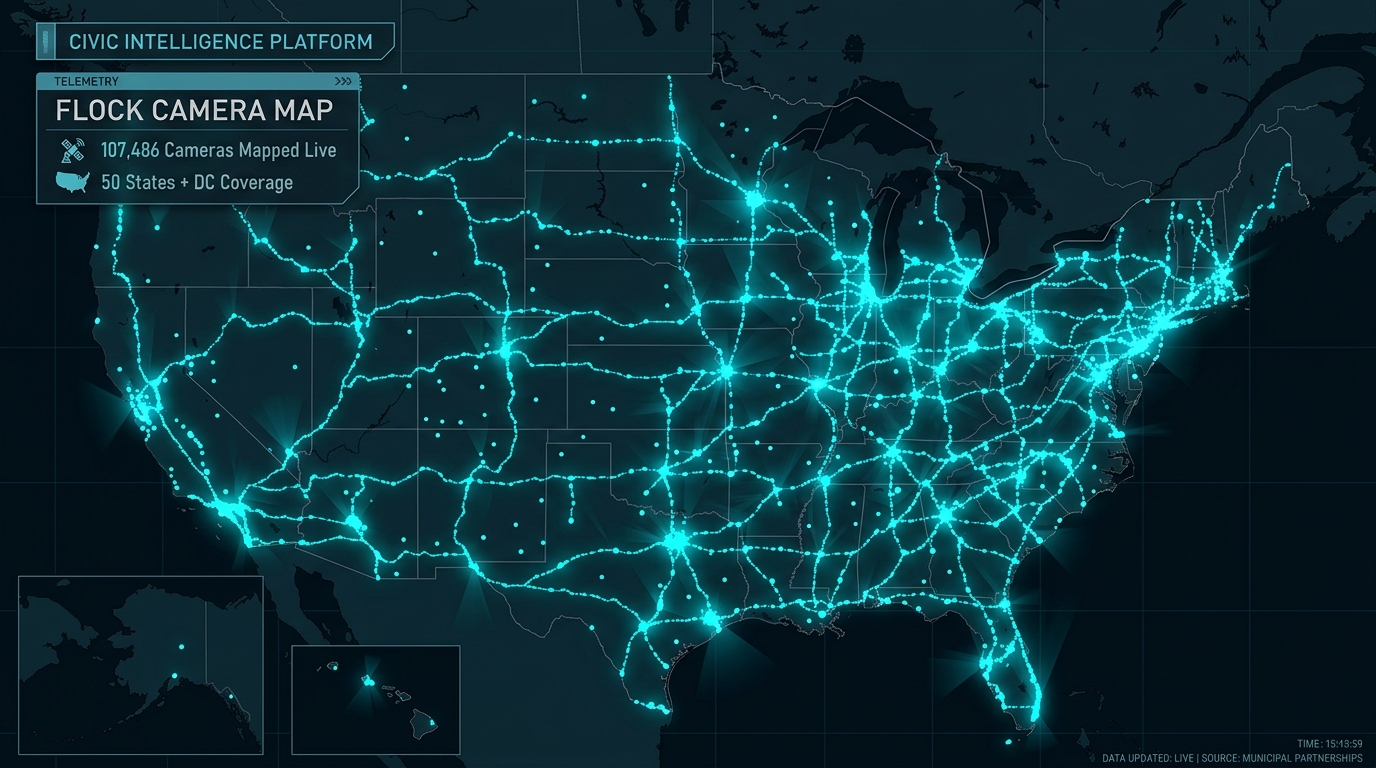
Flock Cameras in Texas: The Lone Star Surveillance Grid
The State of Texas represents one of the largest and most densely populated deployments of Flock Safety automated license plate reader (ALPR) cameras anywhere in the United States. With over 14,000 verified ALPR camera nodes active across municipal police departments, county sheriff offices, constables, and hundreds of private Homeowners Associations (HOAs), Texas is a proving ground for statewide civic surveillance networks.
From the expansive freeway interchanges of the Houston metroplex to the suburban corridors of North Texas (Dallas–Fort Worth) and the rapidly expanding tech corridors of Austin, Flock Falcon cameras monitor tens of millions of vehicular trips every day.
This comprehensive investigative report details the city-by-city camera counts, law enforcement data sharing agreements, legal frameworks, and citizen resources for tracking Flock cameras in Texas in 2026.
1. Texas Statewide Camera Numbers & Geographic Distribution
According to community-verified public records, municipal budget approvals, and OpenStreetMap GIS telemetry, the distribution of Flock Safety cameras across Texas is concentrated heavily along major interstate corridors (I-10, I-35, I-45, I-20) and major suburban municipalities.
| Metropolitan Region | Verified Camera Count | Primary Operating Law Enforcement Entities | Suburban & HOA Penetration |
|---|---|---|---|
| Greater Houston & Harris County | 4,200+ Cameras | Houston PD, Harris County Sheriff (HCSO), Harris County Constables (Pct 1–8), Memorial Villages PD | Extremely High (>400 private HOAs and commercial districts) |
| Dallas–Fort Worth Metroplex (DFW) | 3,850+ Cameras | Dallas PD, Fort Worth PD, Arlington PD, Plano PD, Frisco PD, Irving PD, Garland PD | Very High (extensive arterial and tollway coverage) |
| Austin & Central Texas | 1,450+ Cameras | Austin PD, Williamson County Sheriff, Round Rock PD, Pflugerville PD, Travis County | High (focused on major retail centers and highway entrances) |
| San Antonio & Bexar County | 1,200+ Cameras | San Antonio PD, Bexar County Sheriff's Office, suburban municipal enclaves | Moderate to High |
| El Paso & West Texas | 650+ Cameras | El Paso PD, border transit corridors | Moderate |
| Rest of Texas (Panhandle, Valley, East TX) | 2,650+ Cameras | Lubbock PD, Amarillo PD, Corpus Christi PD, Tyler PD, Texas DPS highway interdiction | Rapidly growing countywide sheriff networks |
2. In-Depth City Breakdown: Major Texas Metroplexes
Houston & Harris County: The Capital of ALPR Surveillance
Houston and surrounding Harris County boast the dense concentration of license plate readers in the American South.
- The Constable Network: In Harris County, eight distinct elected Constable precincts operate independently of the Houston Police Department. Nearly every precinct has procured dedicated Flock networks, creating an overlapping web of surveillance where a single commuter might be logged by four separate agencies during a 15-minute commute.
- Memorial Villages & River Oaks: Affluent enclaves and master-planned communities surrounding Houston were among the earliest private adopters of Flock hardware, ringing entire subdivisions with solar-powered cameras to intercept out-of-neighborhood vehicles.
- Explore detailed coordinates on the Houston Flock Camera Map.
Dallas–Fort Worth: Regional Data Sharing Across 30+ Agencies
The Dallas–Fort Worth metroplex features one of the most interconnected regional ALPR sharing networks in the country:
- Unified North Texas Hotlists: Police departments across Dallas, Tarrant, Collin, and Denton counties share camera access through Flock's TALON network. If a vehicle reported stolen in Fort Worth crosses into Plano or Frisco, officers in all jurisdictions receive simultaneous alerts.
- Fort Worth Real-Time Crime Center (RTCC): Fort Worth Police integrates Flock camera telemetry directly into its high-tech Real-Time Crime Center, merging ALPR plate readings with city CCTV cameras and aerial drone feeds.
- Explore local coverage on the Dallas Flock Camera Map and Fort Worth Flock Camera Map.
Austin: Technology, Controversy & Council Debates
Austin's adoption of Flock cameras has followed a uniquely turbulent political path:
- In 2020, community privacy pushback prompted the Austin City Council to temporarily suspend ALPR contracts over Fourth Amendment concerns.
- However, by 2023–2024, rising vehicle theft rates led the council to approve a multi-million-dollar contract reinstating dozens of Flock cameras on high-traffic Austin corridors.
- Explore Austin deployments on the Austin Flock Camera Map.
3. Texas Legal Framework: Are Flock Cameras Legal in Texas?
Citizens frequently question whether 24/7 automated license plate reading is constitutional or statutory under Texas law.
1. The Fourth Amendment & Texas Constitutional Law
Under both federal jurisprudence (United States v. Knotts) and Texas state case law, traveling on public roadways does not confer a reasonable expectation of privacy regarding the exterior of a vehicle or its state-mandated license plate. Because license plates are specifically designed to be publicly readable identifiers, Texas courts have consistently held that photographically logging plates on public streets does not constitute a constitutional "search."
2. Texas Transportation Code & Red-Light Camera Bans
In 2019, Texas enacted House Bill 1631, which famously banned photographic red-light enforcement cameras across the state. Many Texas drivers mistakenly assume this law also applies to Flock cameras.
- Crucial Legal Distinction: HB 1631 strictly prohibited photographic systems used to issue civil or criminal traffic citations for red-light infractions.
- Flock Cameras Are Exempt: Because Flock cameras are categorized as criminal investigative intelligence devices and do not issue automated traffic fines or speed citations, they are entirely exempt from the HB 1631 ban.
3. Public Records & FOIA in Texas (Texas Public Information Act)
Under the Texas Public Information Act (TPIA), government records are presumed public. However:
- Municipal contracts, invoices, and payment amounts paid to Flock Safety are 100% public records.
- Specific latitude/longitude coordinates of cameras and historical vehicle capture logs are frequently withheld by police departments citing security vulnerabilities or ongoing investigation exemptions under Texas Government Code Chapter 552.
4. How Texas Law Enforcement Uses "Vehicle Fingerprint" Technology
Texas agencies using Flock cameras do not merely capture license plate numbers; they utilize Flock's proprietary Vehicle Fingerprint AI™:
- Make, Model, and Generation: Distinguishes between vehicle generations (e.g., a 2018 vs. 2022 Ford F-150).
- Color Classification: Identifies primary and secondary body paint tones.
- Physical Alterations & Accessories: Flags rooftop cargo racks, aftermarket spoilers, bed caps, customized wheels, and distinctive bumper stickers.
- Paper Dealer Tags: Texas has historically struggled with fraudulent temporary paper tags. Flock's AI algorithms were specifically updated to read and log Texas paper buyer tags, flagging expired dates or invalid formatting.
6. The Harris County Constable Precinct Model: A Case Study in Overlapping Surveillance
Nowhere in the United States is municipal ALPR density more pronounced than in Harris County, Texas (encompassing the City of Houston and surrounding unincorporated suburban zones).
The Eight Precincts of Harris County
Unlike most American counties where a single Sheriff’s Office handles county policing, Texas law empowers elected Constables to run independent law enforcement departments with full countywide jurisdiction:
- Harris County Precinct 4 Constable: Patrols northwest Harris County (Spring, Klein, Cypress, Tomball). Operates one of the largest continuous Flock camera networks in the nation, with over 1,200 connected ALPR units monitoring thoroughfares like FM 1960, Highway 249, and Kuykendahl Road.
- Harris County Precinct 5 Constable: Covers west Harris County and the Energy Corridor (Katy, Memorial, Westheimer). Manages more than 800 cameras integrated into subdivision contract deputy programs.
- Harris County Precinct 1, 3, and 8: Extensively deploy cameras across central Houston, the ship channel industrial corridor, and the Clear Lake bay area.
The Contract Deputy Program Phenomenon
In Harris County, suburban civic associations and HOAs frequently participate in the Contract Deputy Program, where the HOA pays the Constable’s Office directly to dedicate patrol deputies exclusively to their neighborhood. As part of these contracts, HOAs frequently fund Flock cameras out of neighborhood dues, which are then handed over to the Constable's dispatchers for 24/7 monitoring. This public-private partnership model has turned Harris County into an unprecedented proving ground for high-density ALPR tracking.
Texas Municipal Procurement Case Studies: Houston, Plano & Fort Worth
When analyzing municipal adoption rates across Texas, distinct procurement strategies emerge between large metroplexes and affluent suburban municipalities:
- Plano Police Department (Collin County): Plano was among the earliest major North Texas cities to replace legacy fixed ALPR cameras with Flock Falcon arrays. The department deployed over 75 cameras at key arterial intersections and highway off-ramps, reporting a measurable drop in organized retail theft and catalytic converter rings within the first 18 months of deployment.
- Fort Worth Real-Time Crime Center (Tarrant County): Fort Worth Police combined Flock ALPR data with automated gunshot detection sensors (ShotSpotter/SoundThinking) and city CCTV feeds, allowing dispatchers to automatically map the predicted flight path of suspect vehicles fleeing crime scenes along I-35W and I-30.
- Suburban Enclaves (Southlake, Westlake, Highland Park): Affluent North Texas enclaves maintain some of the highest per-capita ALPR densities in the state, effectively creating a continuous digital surveillance perimeter around residential neighborhoods.
7. Texas Inter-Agency Hotlists & Border Patrol Integration
A vital concern among Texas civil liberties advocates is how local police camera feeds interact with federal law enforcement:
- Texas DPS Operation Lone Star: The Texas Department of Public Safety (DPS) integrates commercial ALPR telemetry across south and west Texas transit corridors (I-35, I-10, Highway 59/69) to track vehicles suspected of human trafficking or narcotics interdiction.
- Federal Fusion Centers: Local Texas police departments frequently link their Flock camera nodes to regional fusion centers such as the Houston Regional Intelligence Service Center (HRISC) and the North Texas Fusion Center (NTFC), enabling multi-jurisdictional intelligence sharing across local, state, and federal task forces.
5. How to View Texas Flock Camera Locations
Whether you live in Houston, North Texas, Austin, or a rural county, you can audit ALPR installations across the state:
- Statewide Map: Visit our dedicated Texas Flock Camera Directory for regional counts and municipal agency lists.
- Interactive Street View: Launch the full-screen Interactive GIS Map to zoom directly into Texas intersections and highway interchanges.
- Local Scanner: Use the Near Me Tool to scan for the nearest documented cameras along your Texas commute.
Explore These Cameras On The Live Map
Search your state or city to see verified camera locations and vision cones in real time.
Frequently Asked Questions
Common questions addressed in this guide.